Project 004
Wooden Bike Frame Challenge
Designed and fabricated a functional wooden balance bike frame under strict cost and weight constraints, applying CAD modeling, structural reasoning, and iterative testing to a real physical prototype.
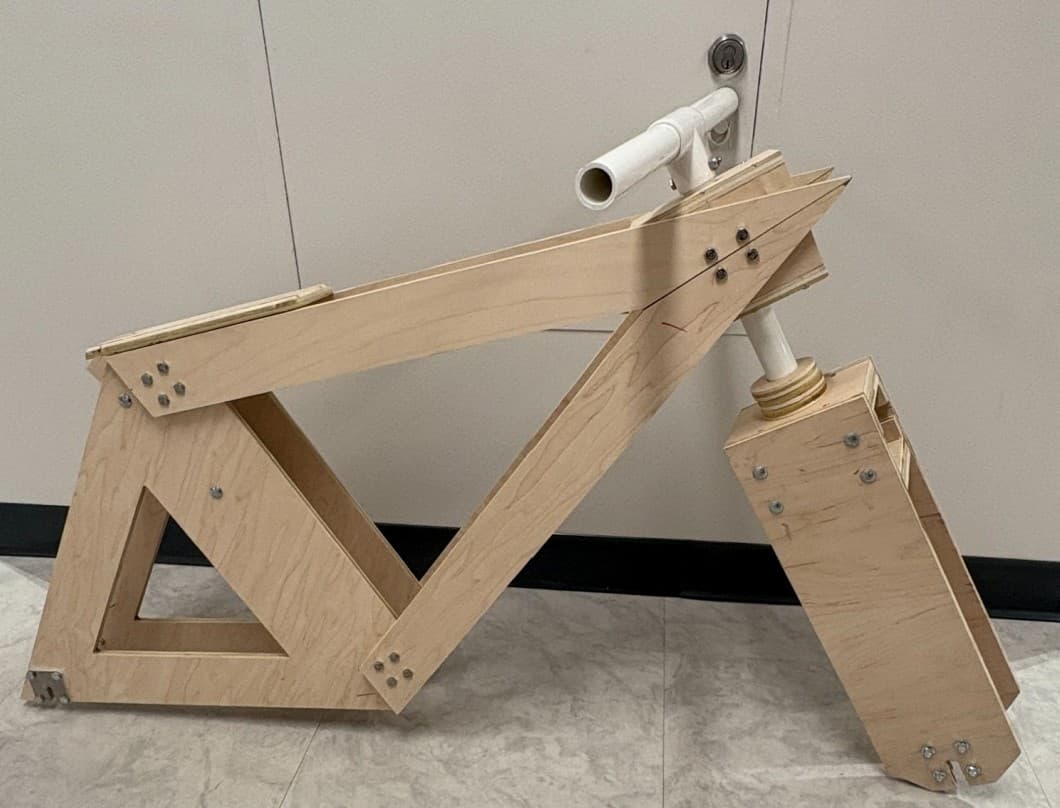
Final Prototype
Overview
The Wooden Bike Frame Challenge required our team to design and manufacture a functional balance bike while meeting engineering constraints related to cost, weight, manufacturability, and performance.
After evaluating multiple concepts, our team selected a low and extended frame design that improved rider stability while making it easier for the rider to push off and maintain balance.
Methodology
Concept Selection
Out of three initial concepts, our team selected a low and extended frame design because it placed the rider closer to the ground, improving balance and making it easier to gain speed.
The design incorporated a 17.3° front fork angle, which allowed the rear triangle geometry to remain equilateral and improved overall stability.
CAD & Manufacturing
The final geometry was refined using CAD before manufacturing. Frame components were produced using a CNC router and assembled using ¼-20 bolts and nuts.
Engineering Decisions
Structural Support
A support piece was added in front of the rear wheel to prevent the frame from bending inward and increase overall stability.
Seat Modification
The original tilted seat design was changed to a flatter configuration to improve rider comfort and stability while pushing.
Results
| Constraint | Target | Result | Status |
|---|---|---|---|
| Cost | Frame under $35 | $29.59 | Pass |
| Weight | Less than 20 lbs | 20 lbs | Pass |
| Assembly | Simple assembly process | Completed with minimal tools | Pass |
| Comfort | Comfortable for users | 2 / 3 comfort rating | Pass |
| Performance | Functional and rideable | Successfully completed riding test | Pass |
The completed wooden bike successfully met every major design requirement of the challenge, balancing cost, weight, manufacturability, and rider usability while remaining fully functional. Iterative testing and evaluation allowed the team to improve on the original concept by increasing structural stability and rider comfort.
Team
Team #214
TJ Hernan • Jameson Porter • Caleb Beswick • Ethan St. John